The Lithuanian labour market is increasingly experiencing a growing demand for qualified specialists, yet the vocational education system still faces challenges in ensuring that the competences acquired correspond to rapidly changing economic and technological needs. Practical experience gained in the workplace is not always clearly assessed or recognised, and the quality of practical training can vary significantly between companies. This limits opportunities to ensure more uniform learning quality and a smooth transition from education into the labour market.
In this context, it becomes particularly important to strengthen the implementation of lifelong learning principles, improve quality assurance mechanisms for practical training, and develop clearer solutions for assessing and recognising competences acquired in the workplace. These are essential conditions for a more sustainable and competitive labour market.
Considering these challenges, two interrelated projects are being implemented under the Lithuanian-Swiss Cooperation Programme 2024–2029 in the field of vocational education and training: “MASTER STEPS. Development and Piloting of a Workplace – Based Mastery Qualifications Model” and “Q-TRACK. Development of Quality Assurance Model for practical work – based training”.
The “MASTER STEPS” project aims to develop and pilot a model for master-level qualifications acquired in the workplace, enabling the systematic assessment and recognition of competences gained in professional activity by linking them to the national qualification’s framework. During the project, qualification descriptions and methodological materials are being developed, and assessment processes are being tested in real conditions.
Meanwhile, the “Q-TRACK” project is focused on developing and piloting a quality assurance model for practical workplace training. It includes the analysis of international practices, the preparation of recommendations, the development of quality requirements, and testing their application in companies, to ensure a more consistent and higher standard of practical training.
The Swiss Confederation makes a significant contribution to the implementation of these initiatives by sharing its experience in vocational education and best practices. This cooperation enables Lithuania to apply internationally based solutions, strengthen the quality of vocational education, and develop more advanced workplace-based training models.
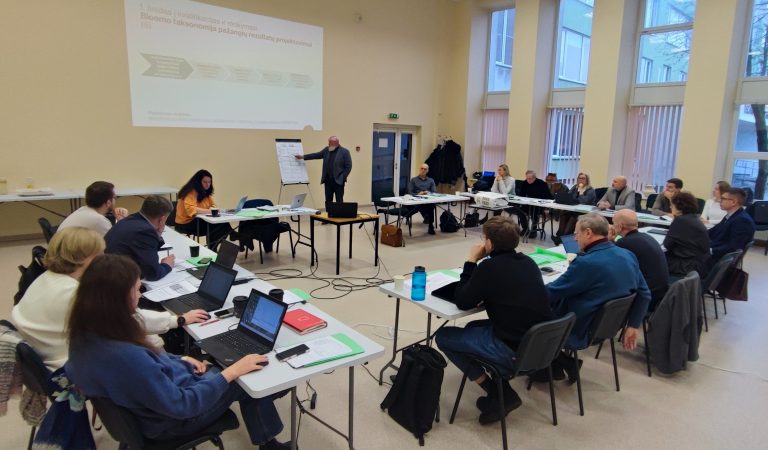
In implementing the “MASTER STEPS” project, a preliminary analysis of the development and potential of selected economic sectors has been carried out, professional activities in different sectors have been assessed, and a set of master qualifications has been formed for piloting. An introductory meeting with project partners has also taken place, during which activities were presented and implementation principles and administrative issues were discussed.
Meanwhile, the “Q-TRACK” project has already begun analytical activities aimed at developing a quality assurance model for workplace-based practical training. A brief review of European, Canadian, and Australian practices has been prepared, and a set of parameters for comparison has been developed, forming the basis for further analysis and model development.
These projects are consistently contributing to the development of a more modern vocational education system in Lithuania – one that better responds to labour market needs, strengthens the recognition of practical competences, and promotes high-quality workplace learning.