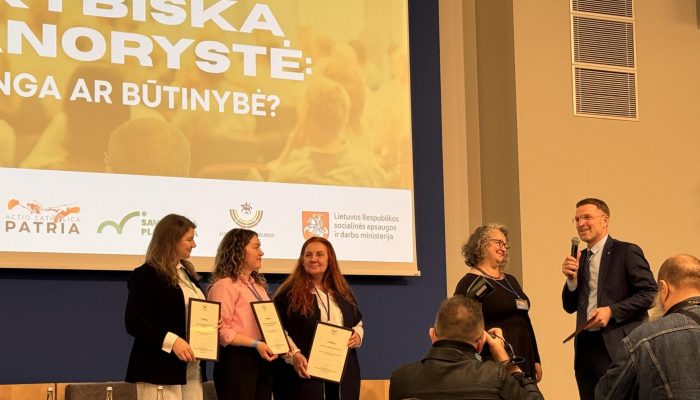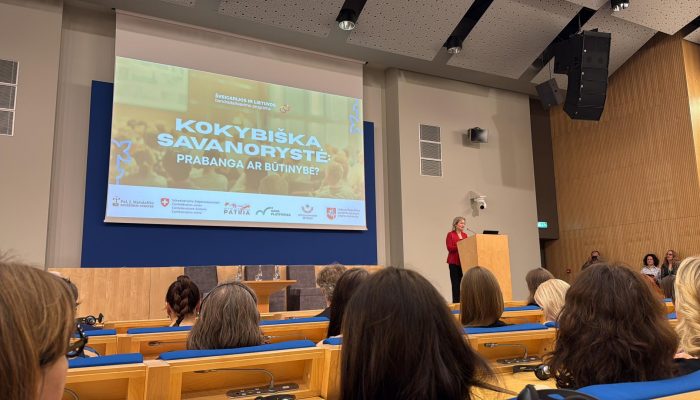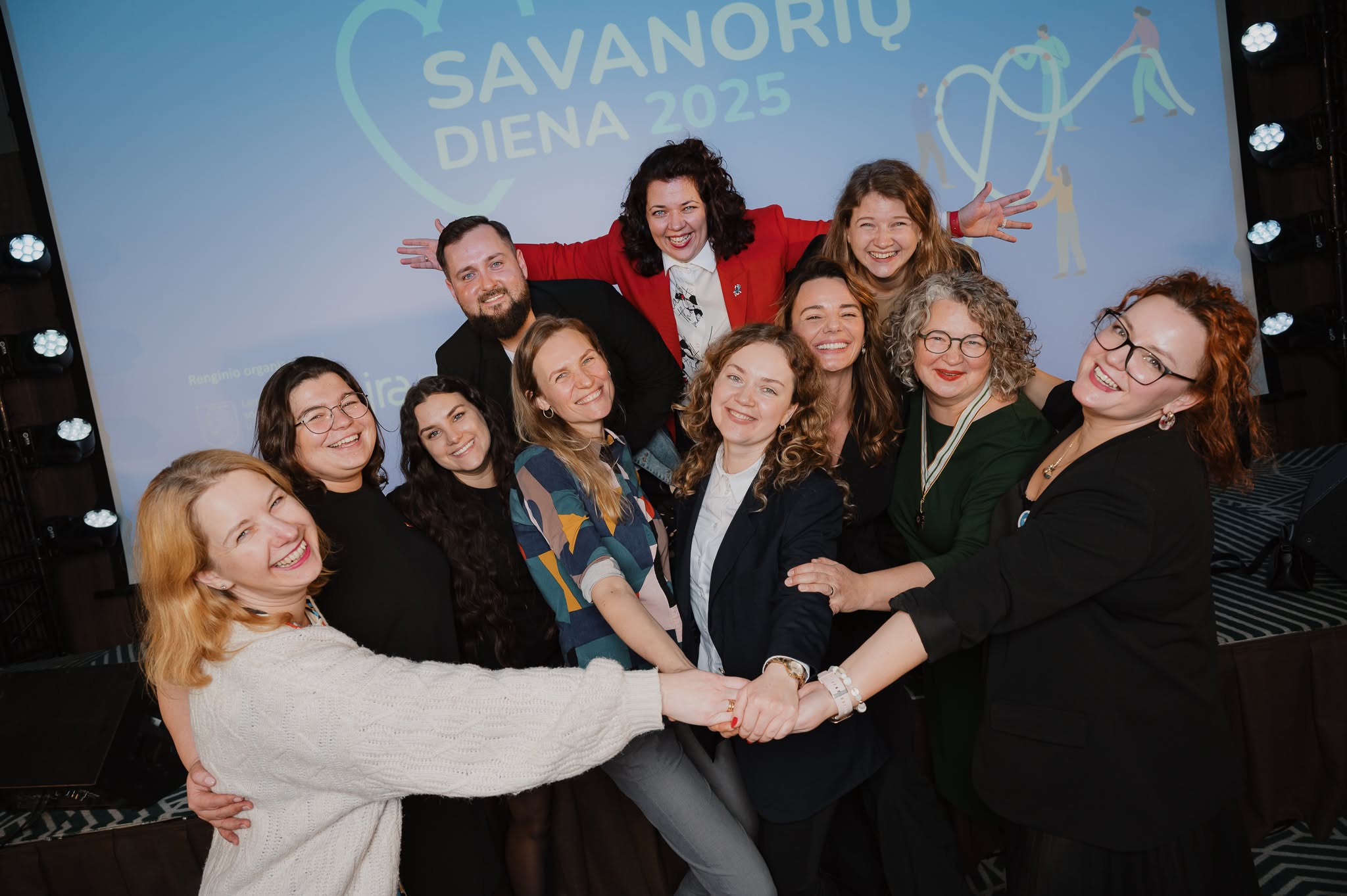
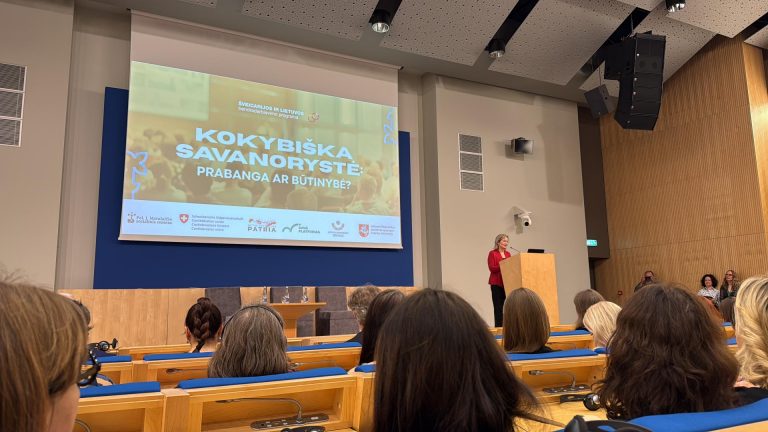
Today, around 16% of the population in Lithuania volunteers, and the goal of the “Civic Engagement” programme of the Switzerland–Lithuania Cooperation Programme 2024-2029 is to increase this figure to at least 22% by 2030. One of the key steps toward achieving this growth is the development of a National Volunteering Standard, which will strengthen volunteer coordination capabilities in Lithuania. On this topic, an international conference titled “Quality Volunteering: A Luxury or a Necessity?” was held in Vilnius on March 19th as part of the project “Quality improvement for volunteer coordination” of the programme.
The project is implemented by the Blessed J. Matulaitis Social Center, a public institution, together with its partners – the public institutions “Actio Catholica Patria” and “SAVA visiems.” In Lithuania, the Central Project Management Agency (CPMA) is responsible for administering the programme, and the Ministry of Social Security and Labor of the Republic of Lithuania also contributes to its success. The Ministry of Finance of the Republic of Lithuania serves as the National Coordination Unit, ensuring that activities are coordinated and consistent.
The conference brought together non-governmental organisations and representatives from various sectors, while insights from experts in Switzerland and Ireland added an international perspective. In Switzerland, more than a third of the population participates in voluntary activities, making the country’s experience an important reference point for Lithuania. Swiss Ambassador to Latvia, Lithuania and Estonia Anja Zobrist Rentenaar delivered opening remarks at the event, while foreign experts presented best practices and examples of volunteering policies, demonstrating how their experience could be adapted in Lithuania.
According to the Swiss Ambassador, this conference is an excellent example of close and constructive cooperation between Switzerland and Lithuania: “Through our partnership, including the Switzerland–Lithuania Cooperation Programme, we are working together to strengthen civil society, promote citizen engagement, and support initiatives that bring tangible benefits to our communities.”
During the conference, the results of a study on volunteers’ satisfaction with volunteering were discussed, thematic discussions were held, and interactive working groups were formed to discuss the challenges of volunteering and possible solutions, as well as to provide suggestions for improving the draft National Volunteering Standard.
According to Dr. Neringa Kurapkaitienė, co-author of the National Volunteering Standard and a volunteering consultant, people’s motivation is not the main problem – many people want to volunteer. Far more often, organisations lack the readiness to work with volunteers: there is a lack of clear processes, training, and feedback. Sometimes there isn’t enough capacity to assign a person to coordinate volunteers.
The National Volunteering Standard, which was presented to the public for the first time during the conference, will help fill these gaps. “The Volunteering Standard is designed to provide organisations with a common framework: how to accept a volunteer, how to integrate them into activities, and how to ensure that their experience is meaningful and of high quality. Volunteering is a relationship between a person and an organisation, so it is very important that this relationship be clear, respectful, and beneficial to both parties,” emphasised Dr. N. Kurapkaitienė.
The speakers stressed that high-quality volunteering is not a privilege but a necessity in modern society, strengthening trust, fostering cooperation, and building connections between communities. “Volunteering creates meaningful change in society – it inspires people to get involved, collaborate, and build community. Volunteers are incredibly important because they give not only their time but also their hearts. What they create often surpasses any monetary reward – it is kindness, human connection, and the belief that one person can do so much for another. Having worked and volunteered in a volunteer organisation for many years, I deeply believe in this project and wish it the very best of success,” noted Brigita Nikonovičė, Senior Project Manager at CPMA.
The event was a successful part of the Lithuanian-Swiss Cooperation Programme in the field of volunteering, enabling the adoption of international best practices, the implementation of high standards for volunteering, the strengthening of organisational capacities, and the promotion of sustained civic engagement in Lithuania.
The project “Quality improvement for volunteer coordination” is funded under the “Civic Engagement” programme of the 2024-2029 Cooperation Programme between the Swiss Confederation and the Republic of Lithuania, which promotes the development of volunteering and active public participation in the life of the state. (For more information: HERE).