
Across the EaP region, thousands of young people, volunteers, jobseekers, and adults acquire competencies outside the classroom through community work, youth organisations, digital learning or spontaneous volunteering, yet these skills often remain invisible in the labour market. Austria’s model shows how a country can turn such experience into recognised competences that support employability, mobility and lifelong learning.
On 27-28 November 2025, more than 80 representatives from Eastern Partnership countries and the European Union joined a virtual study visit to Austria to learn how non-formal and informal learning can be formally recognised and converted into valuable qualifications.
The event was organised within the “EU4Youth: Youth Employment and Entrepreneurship” programme in cooperation with the European Centre for Freedom and Independence (EUCFI, Austria).
The programme featured contributions of the EU partners (European Training Foundation, SALTO Eastern Europe and Caucasus Resource Centre) and wide range of Austrian public institutions, research bodies and youth sector organisations, including the Federal Ministry of Economy, Energy and Tourism, the Federal Ministry for Labour, Social Affairs, Health, Care and Consumer Protection, Austria’s Agency for Education and Internationalisation, the Federal Chancellery (Youth Competence Centre), the Austrian Institute of Technology (AIT), WienXtra – Institute for Leisure Education.
During the two-day event, Austrian stakeholders demonstrated how validation becomes effective when embedded in national standards, supported by employers and linked to the National Qualifications Framework. Participants explored practical tools such as the aufZAQ certification system, Digital Volunteer Passport, assessor training systems and the accreditation of youth-work competences.
For EaP institutions working to modernise employment services, strengthen youth policies and address skills shortages, the Austrian experience provides a concrete roadmap: invest in clear competence standards, build cross-ministerial partnerships, and create accessible pathways for recognising learning wherever it takes place.
The Study Visit marked an important step in expanding regional capacity to design validation systems that support youth employability, social inclusion and resilient labour markets across the Eastern Partnership.
Speaking after the event, Evgeniia Petrivska, Key Expert of the “EU4Youth – Youth Employment and Entrepreneurship” programme, underlined the relevance of the topic:
“Recognising skills gained beyond formal education is no longer optional – it is essential for building inclusive, future-ready labour markets. This online study visit demonstrated how cooperation between governments, civil society and social partners can turn non-formal learning and volunteering into meaningful opportunities for young people. We are pleased to see strong motivation among Eastern Partnership countries to continue advancing their validation systems”.
Photo of Evgeniia Petrivska:
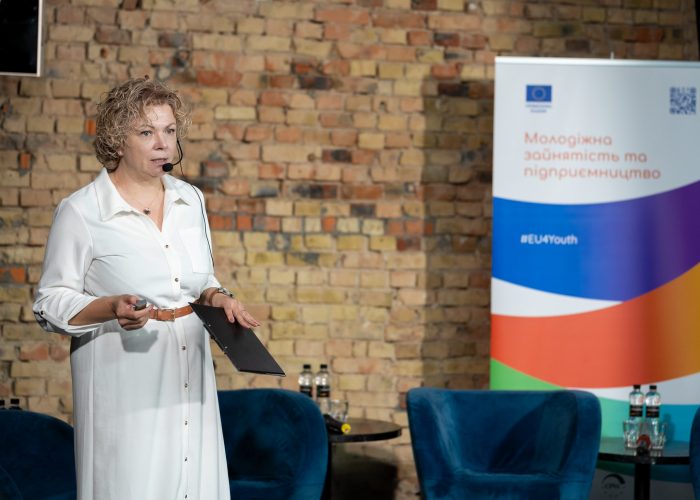
“Austria’s experience proves that recognising skills from non-formal learning and volunteering is a long-term investment in people. Thanks to strong cooperation and strategic planning, validation becomes a tool for employment, inclusion, and resilience – and a powerful model for Eastern Partnership countries. We are proud to support this exchange”, said Olena Bekreniova, Co-Founder of the European Centre for Freedom and Independence (EUCFI, Austria).
Photo of Olena Bekreniova:

Recordings of the virtual study visit are available here: Day 1, Day 2.
The “EU4Youth Phase III – Youth Employment and Entrepreneurship” programme, funded by the European Union and the Ministry of Foreign Affairs of Lithuania, is being executed by the Central Project Management Agency (CPVA) in Eastern Partnership countries. The programme will run until the middle of 2026 and aims to provide technical assistance to governmental and non-governmental organisations to tackle youth unemployment and improve employability.