A hundred years ago, the Soviets tried to break the Ukrainian nation through famine. Today, Russia is trying to do the same through cold. For four years now, and especially during this harsh winter, Russia has deliberately targeted and destroyed Ukraine’s energy infrastructure, seeking to break the will of Ukrainians to resist. Yet it appears that the absence of electricity, heating, and water – even in biting -20°C temperatures – will not break the country’s people. Lithuania’s support, helping to modernize Ukraine’s energy sector, also plays an important role in this resilience.
A century ago – Holodomor, now – cold
Nearly a hundred years ago, the Soviet regime attempted to break the Ukrainian nation through the Holodomor. Today, among many other methods, Russia is attempting to do so through cold. In 1932–1933, the enemy deliberately took food from Ukrainians, confiscated grain, closed borders, and condemned millions to death by starvation. In 2022, with the start of the full-scale war, and especially this winter, Russia has been systematically destroying Ukraine’s energy infrastructure – power plants, heating networks, and substations – in order to leave people without heating, electricity, and water, and thus break their will to resist.
This year alone, Russia has carried out at least three massive attacks on Kyiv’s energy infrastructure. After the January 9 attack, nearly 6,000 apartment buildings in Kyiv were left without heating, while temperatures outside in some places dropped to -20°C. Mayor Vitali Klitschko even urged residents to temporarily leave the capital. Around 600,000 people reportedly followed this advice. Kyiv region and major cities across the country – Kharkiv, Zaporizhzhia, Dnipro, Odesa, Kryvyi Rih, and Chernihiv – also experience near-daily attacks on energy infrastructure.
Energy sector – a Soviet-era legacy
Russia knows exactly which infrastructure to destroy in order to trigger a humanitarian catastrophe. Most apartment buildings in Kyiv and other cities depend on centralized heating. The old Soviet energy model was based on centralization, relying on a limited number of large combined heat and power plants (CHP), thermal power plants (TPP), and nuclear power plants (NPP), with highly centralized heat and electricity supply and very low energy efficiency of buildings – shortcomings that were offset by cheap energy resources from Siberia.
Power outages have accelerated modernization
However, electricity outages and Russian attacks on the energy system have accelerated modernization of Ukraine’s energy sector, carried out by Ukrainian institutions with support from Lithuania.
Across the country, homes, hospitals, schools, kindergartens, and power facilities are being modernized on a large scale to become more energy-efficient, economical, and in some cases fully autonomous.
Public infrastructure – especially healthcare and education facilities – are among the largest consumers of heat and electricity. These are often large buildings that must be kept warm continuously and require significant energy so that kitchens, laboratories, and operating rooms can function without interruption.
Some of these institutions had already been partially modernized after Ukraine’s 2015 decentralization reform: schools and hospitals were insulated and old windows replaced with more energy-efficient ones. However, the full-scale invasion made this problem even more urgent.
Lithuania was among the first foreign partners to come to Ukraine’s aid, helping to restore facilities heavily damaged during the war. Importantly, reconstruction followed a new model – creating new, far more efficient buildings.
“Ruta” kindergarten in Irpin – a modernization example
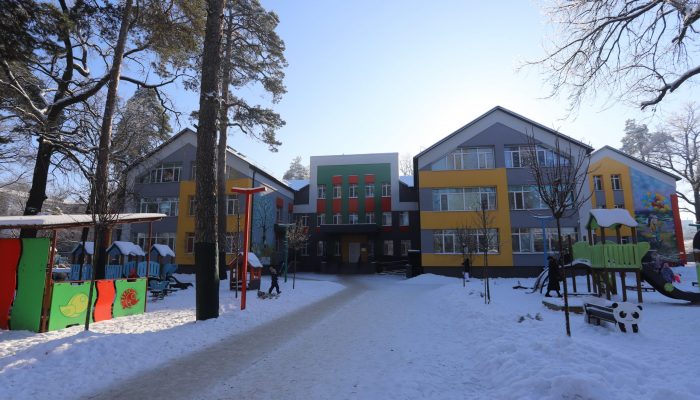
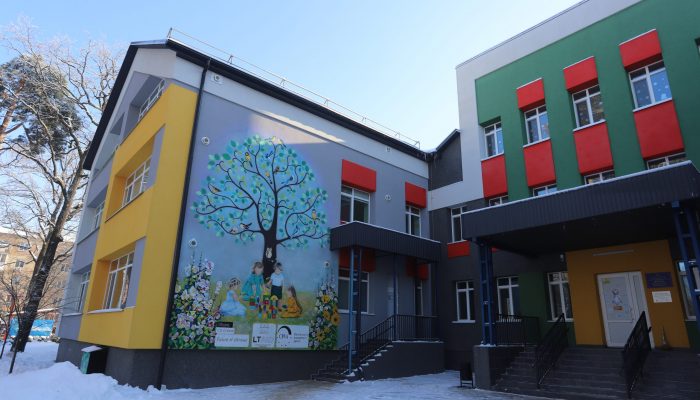
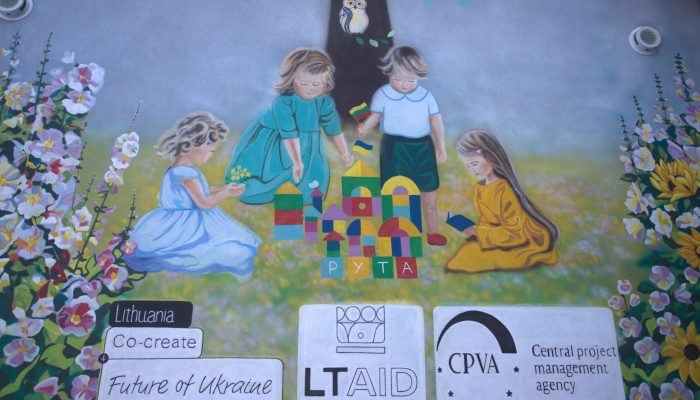
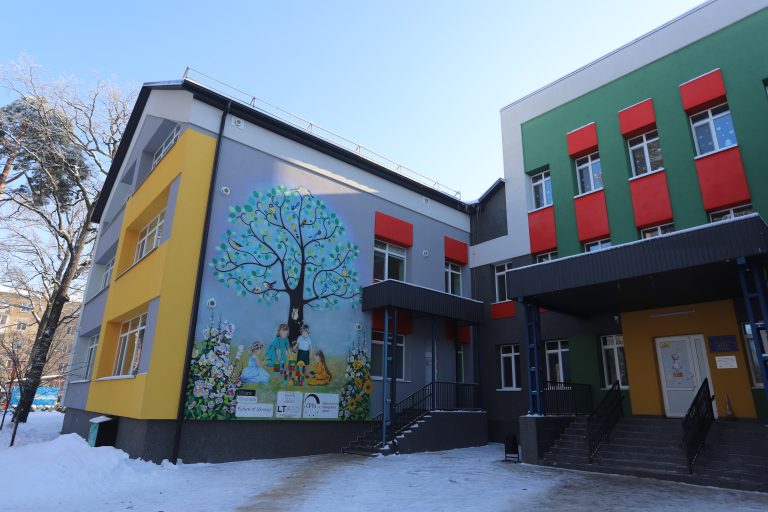
A good example of modernization is the “Ruta” kindergarten in Irpin, a city where many buildings and infrastructure were destroyed during heavy fighting for Kyiv.
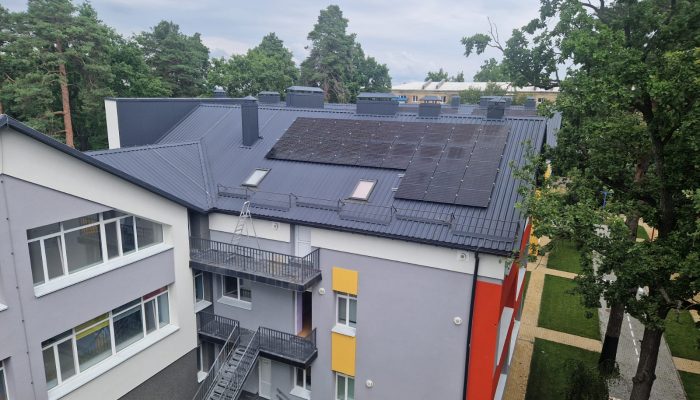
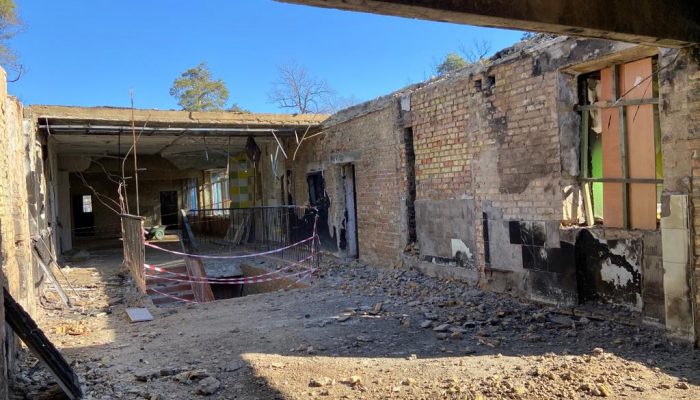
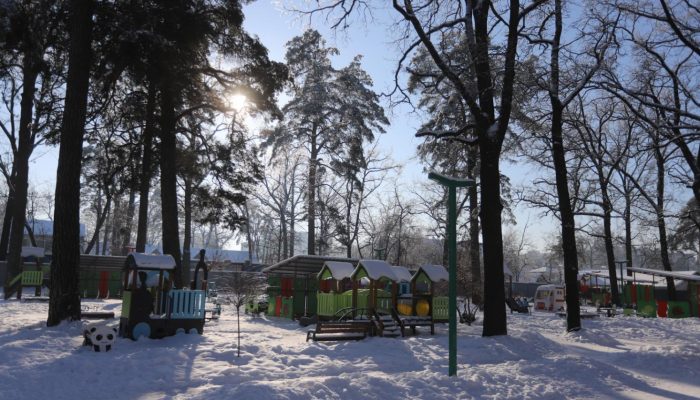
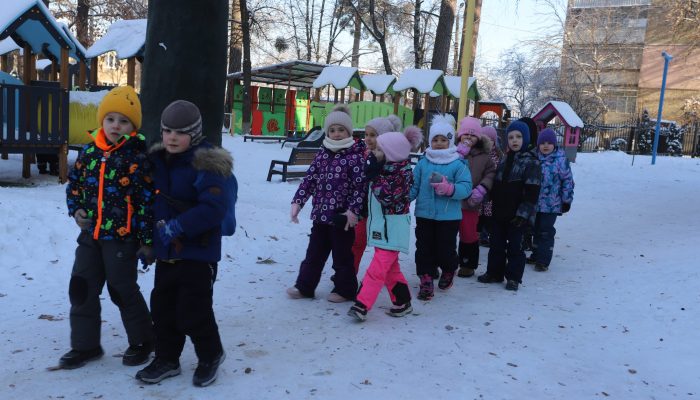
After liberation, 75% of the kindergarten building had been destroyed. Using Lithuanian funds, the Central Project Management Agency (CPVA) carried out reconstruction in 2022–2023: a shelter was installed, the facility was equipped with furniture and equipment, and modern playgrounds were built outdoors. Today, more than 300 children attend the kindergarten at the same time. The premises are warm and comfortable, and electricity is supplied without interruption – even when power is unavailable for up to 20 hours per day. How is this possible?
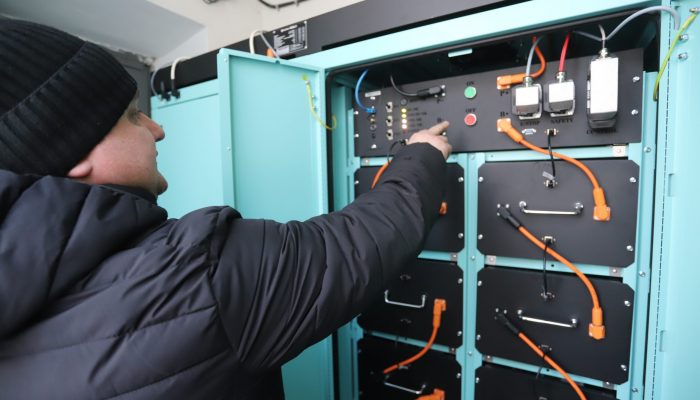
The kindergarten has its own boiler house running on environmentally friendly fuel. The boilers are new and significantly more efficient than the old ones. All heating networks are fully insulated. But the most important upgrade is the power supply system. During reconstruction, 10 powerful battery blocks with a total capacity of 300 kW were installed, allowing the kindergarten to operate almost fully autonomously throughout the working day.
The reconstruction was carried out with the support of the Lithuanian government, a long-standing partner of Ukraine implementing numerous education and healthcare modernization programs.
“Our power plant is the most powerful in the entire region. Other preschools have 30 kW systems. We have 300 kW – ten times more,” says kindergarten director Kseniia Katrych. “That means five hours of uninterrupted operation together with kitchen equipment. Why is this important? Because stoves, ovens, combi-steamers, and meat grinders account for up to 70% of total electricity consumption. This is very important for children.”
The kitchen will continue to be modernized to further reduce energy consumption. Already, in warmer months, batteries easily store energy from rooftop solar panels installed in autumn with Lithuanian support.
Under the CPVA project, when solar energy is insufficient and grid electricity is unavailable, the system is supported by a large diesel generator consuming up to 20 liters of fuel per hour. Energy flows from solar panels, the generator, or the city grid are managed by an automated system ensuring uninterrupted power supply. All this equipment is installed in a large shelter that can accommodate all children and staff. There are even sleeping rooms for younger groups. For many children, it is now warmer here than at home.
Solar power in hospitals protects critical equipment and saves lives
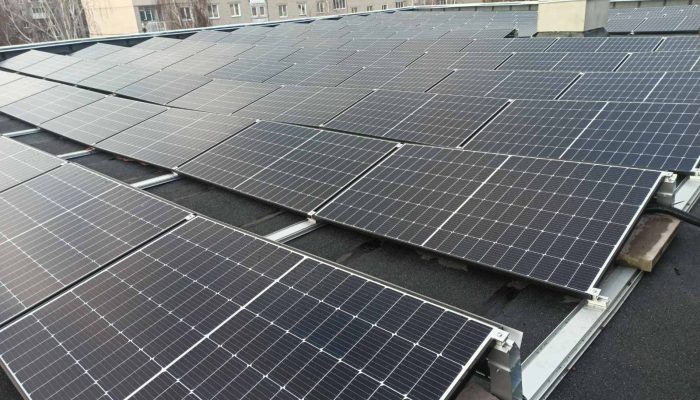
CPVA also installed a solar power plant at one of Kyiv’s largest hospitals – City Clinical Hospital No. 6. A 135 kW solar power system with energy storage capacity of 400 kWh was mounted on the roof. This system ensures stable electricity supply during grid outages and helps protect critical medical equipment, allowing the hospital to continue operating without additional generators.
Hospital management emphasizes the life-saving importance of Lithuanian support:
“This project is first and foremost humanitarian,” says chief power engineer Roman Pastukh. “We are effectively energy-independent and can work even in the most difficult conditions. We save lives. Doctors can trust that equipment will not stop, operations will be completed, and the most vulnerable patients and children will be safe.”
Hospital No. 6 is a multi-profile facility consisting of 17 buildings. According to administration, the CPVA-installed solar power plant significantly reduces overall electrical load and ensures uninterrupted treatment.
“A 135 kW solar plant can significantly reduce electricity costs in one summer month. Energy storage batteries ensure stable supply for a certain time. In laboratories, batteries act as uninterruptible power supplies and protect expensive equipment from voltage surges and outages. In operating rooms, they maintain power when voltage drops. In the children’s hospital, batteries reduce frequent outages and save generator fuel. In intensive care units, energy storage systems can save lives for several hours during outages, especially for critically ill patients on ventilators,” the administration explains.
Solar power in schools reassures parents
Under a CPVA project, a solar power plant was also installed at a lyceum in Novovolynsk, Volyn region. According to principal Maja Kliofa, besides ensuring energy independence, the system significantly reduces electricity expenses, freeing funds for other needs.
“Knowing that lighting, communication, and security systems always work at the lyceum, we feel much calmer about our children’s safety. It gives a sense of reliability and security in this extremely difficult time,” say parents.
“Despite electricity outages lasting 15–17 hours a day, we can conduct lessons without disruption, use digital tools, and feed children, since our cafeteria equipment is electric. Most importantly, this solar power plant helps protect students’ emotional and psychological well-being, which suffers greatly during prolonged outages,” says Irina Tolochko, head of a gymnasium in Berdychiv, Zhytomyr region.
Lithuania and CPVA continue supporting Ukraine
Lithuania and CPVA, which has already implemented numerous reconstruction projects in Ukraine, state that they will continue providing support, as Ukraine’s success and ability to resist Russian aggression are also crucial for Lithuania’s own security.
“Our priority was speed,” says Natalja Aldochina, CPVA project manager responsible for the solar power project. “By the end of last December, we installed ten of the twenty planned solar power plants. The remaining ones are expected to be completed by February 2026. Savings during the project allowed us to include six additional critical infrastructure facilities – hospitals and schools.”
This time, solar power plants will be installed in educational institutions in Chernivtsi, Volyn, Zakarpattia, and Odesa regions, as well as in hospitals in Rivne and Ivano-Frankivsk regions.
Prepared based on a Kyiv Post article
Photos: Sergii Kostezh / Kyiv Post and CPVA