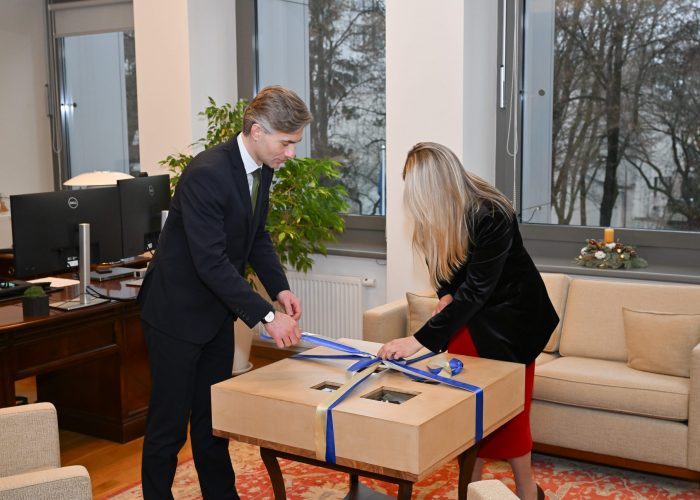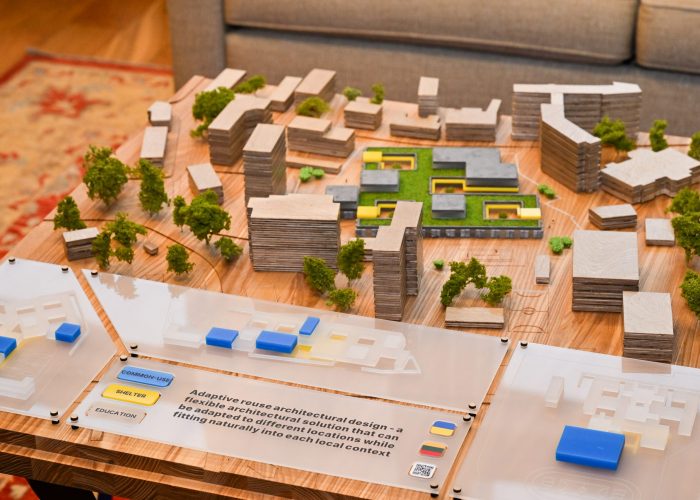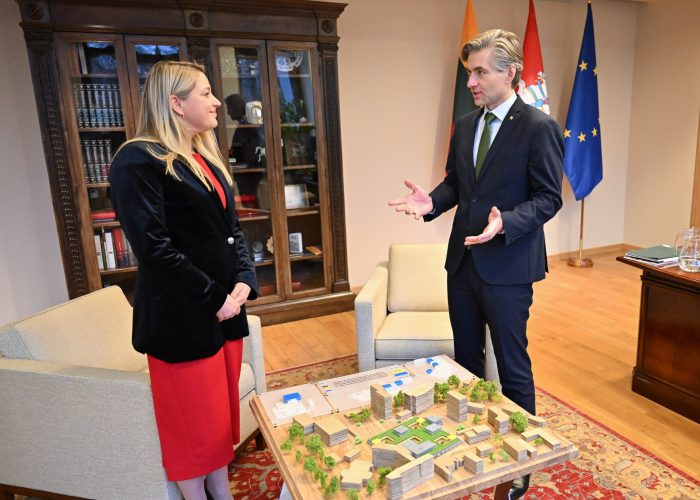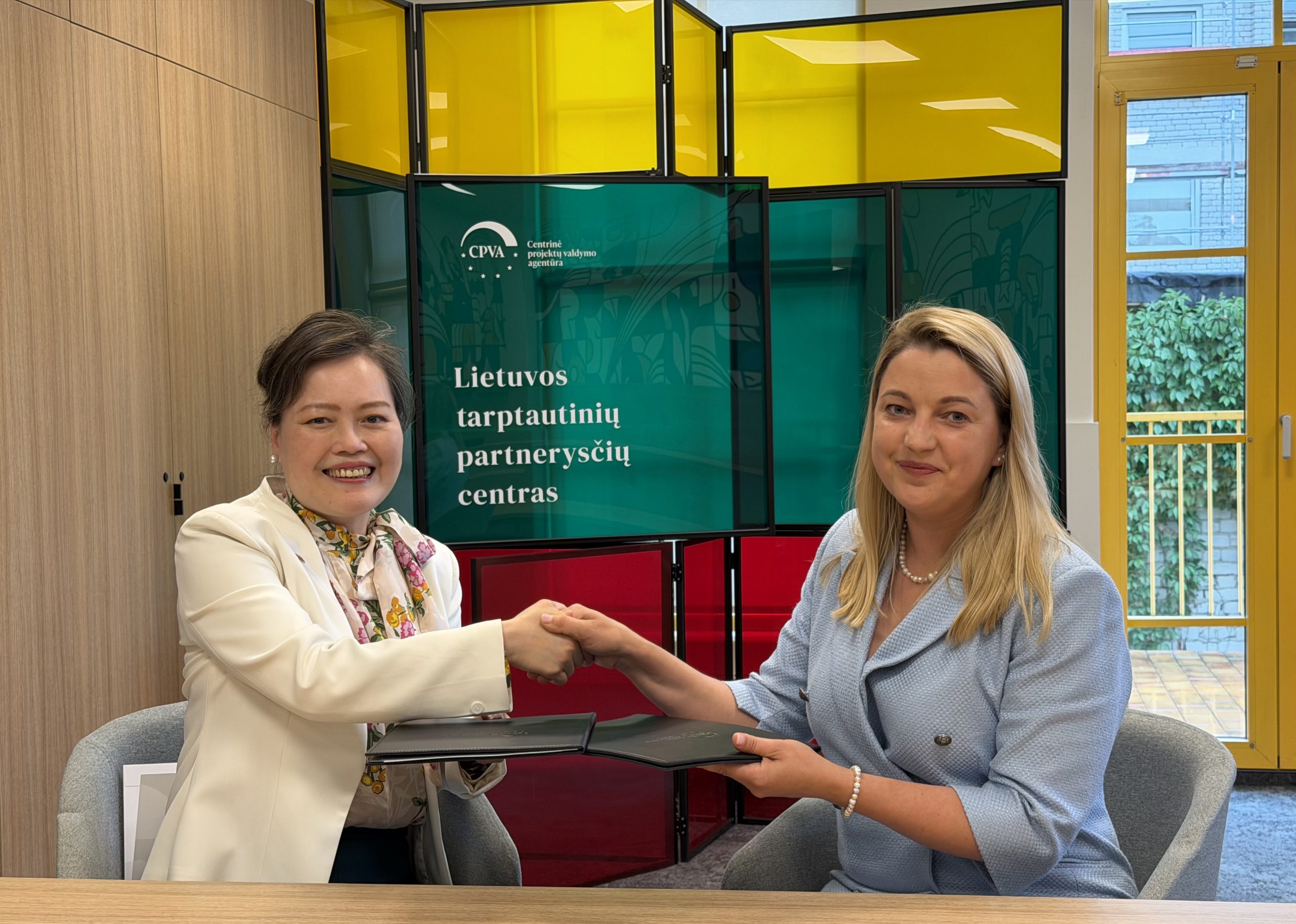
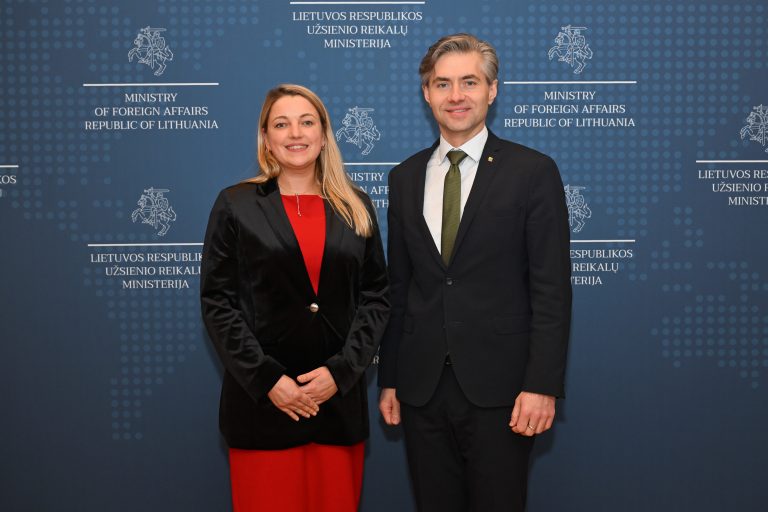
On 18 December, the Central Project Management Agency (CPVA) Director Indrė Šuolienė visited the Ministry and presented Minister K. Budrys with a model of the adaptive technical project “Future School for Ukraine.” The model shows not only how the new school in Zhytomyr will look, but also how the same design can be adapted to different locations across Ukraine, depending on land conditions, community needs, and safety requirements.
Lithuania continues to strengthen its support for Ukraine and aims to ensure that the reconstruction of the country’s war‑damaged education infrastructure is not only fast but also systematic, reflecting real conditions and long‑term needs. One of Lithuania’s key contributions is the adaptive technical project “Future School for Ukraine,” which will be used for the reconstruction of the first school in Zhytomyr.
The project is based on Lithuania’s early experience in Ukraine. In 2022, Lithuania became one of the first countries to begin rebuilding schools and kindergartens after Russia’s full‑scale invasion. Initially, the focus was on reconstruction, but as projects progressed, it became clear that this alone was not enough.
Ukraine’s education system continues to face major challenges due to the ongoing war. According to the Ministry of Education and Science of Ukraine, more than 3,000 schools have been damaged, and around 500 have been completely destroyed. This has deepened the already existing gap in education quality. PISA 2022 data shows that the learning gap between urban and rural children in Ukraine is nearly four years, and many sixth‑graders have never attended school in person due to the pandemic and the war.
The “Future School for Ukraine” project is designed specifically for schools operating under wartime conditions. It includes built‑in safety solutions, flexible learning spaces, and underground shelters that ensure the safety of students and staff during air alerts and allow learning to continue even in extreme situations.
“While implementing the projects, we realized that it is not enough to simply rebuild individual objects. If we want the reconstruction to be faster and more sustainable, we have to solve systemic problems. Therefore, we sought to create a model that could be widely applied and used by other donors. Similar changes have already taken place with underground shelters and rehabilitation centers in Ukraine—initiatives that have grown from individual projects into broader, system-building programs. We believe that this model will have a similar impact,” says Indrė Šuolienė, director of Central Project Management Agency.
To create this solution, an international architectural competition was held, bringing together architects, engineers, and education experts from more than 10 countries. Fifteen proposals meeting the requirements were submitted and evaluated by an international jury. The winning design was created by a team of Italian and Ukrainian architects. In Lithuania, this procurement was recognized as the Public Procurement of the Year.
The winning adaptive school design will meet local needs and the specific challenges faced by schools operating during wartime. The built‑in safety solutions and underground shelters will help protect students and staff and ensure continuity of learning. The technical project will be available free of charge for school construction across Ukraine – both for Ukrainian institutions and international partners.
The model will also serve as a practical tool for the Ministry in discussions with international partners, helping to visually present the challenges faced by Ukraine’s education system and to engage international, educational, and business communities in supporting Ukrainian children’s right to education.
The “Future School for Ukraine” project is implemented by the Central Project Management Agency (CPVA) together with the Ukrainian Agency for Restoration and Infrastructure Development and the Lithuanian Union of Architects. The project is funded with Eur 500,000 from the Development Cooperation and Humanitarian Aid Fund.