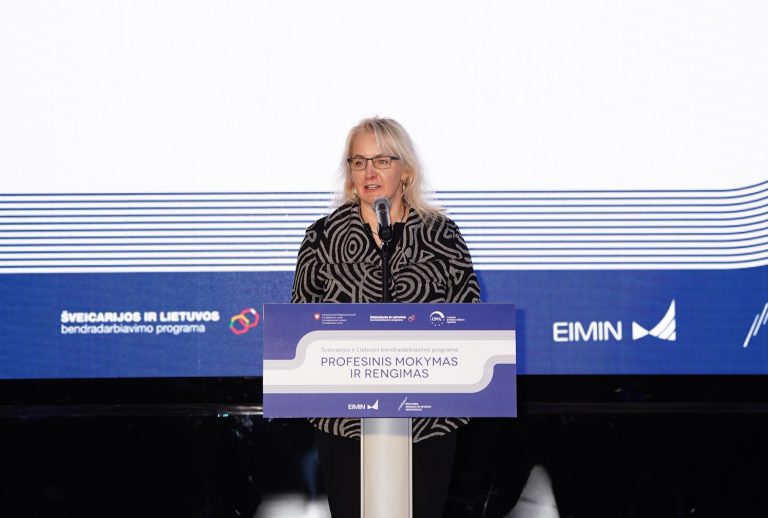
Lithuania is launching the implementation of the Vocational Education and Training programme under the Lithuanian–Swiss Cooperation Programme, which aims to strengthen lifelong learning, promote partnerships between education and business, and create more favourable conditions for the integration of immigrants into the labour market.
“We are opening a new chapter in the history of cooperation between Lithuania and Switzerland—a partnership we have been building for more than three decades,” said Martin Michelet, Ambassador of Switzerland to Lithuania. “Through the implementation of the Vocational Education and Training programme, Switzerland and Lithuania will be deepening bilateral relations in a new field.”
Switzerland is renowned for its advanced dual VET system, which combines theoretical learning with practical training. As many as two-thirds of Swiss young people choose vocational education. This model contributes to the country’s low unemployment rates. In the third quarter of 2024, the unemployment rate in Switzerland stood at 4.7%, compared with 6.8% in Lithuania and 5.8% in the EU. Youth unemployment (up to 24 years) reached 7.9% in Switzerland, while in Lithuania it was 19.6% and 14.5% in the EU.
“Switzerland is an excellent example of how well-functioning qualifications systems can become the foundation of economic success. This programme will not only help Lithuania implement the necessary changes in its VET system, but will also provide long-term benefits for society,” said Lidija Kašubienė, Director of the Central Project Management Agency (CPVA).
According to Karolis Žemaitis, Vice-Minister of the Economy and Innovation, initiatives such as this can significantly contribute to Lithuania’s competitiveness in the global market.
“Our goal is to build a strong, high value-added economy, and this requires ensuring an adequate supply of skilled talent and promoting competencies that meet labour market needs. I have no doubt that this programme will be an important step in strengthening the skills and supply of our talent pool,” said Mr Žemaitis.
Deputy Minister of Education, Science and Sport Agnė Kudarauskienė noted that the field of vocational education has undergone many changes over the past decade—from infrastructure modernisation to improvements in training quality. However, she emphasised the need to continue these efforts.
“There is now a kind of ‘hunger games’ for talent. We find ourselves in a situation where vocational education is becoming extremely significant. When speaking about Lithuania’s competitiveness, we must recognise that it cannot be achieved without investment in education. And the VET system is one of the fastest and most flexible in adapting to economic needs,” the Deputy Minister stressed.
Upon implementation of the programme, Lithuania will develop and test models for recognising workplace-acquired qualifications and competences, as well as quality assurance models for non-formal workplace learning. VET programmes will also be adapted to the needs of third-country nationals to support their integration into the labour market.
The Vocational Education and Training programme is financed from the Second Swiss Contribution. A total of approximately 4.4 million Swiss francs (EUR 4.7 million) has been allocated for its implementation, with Lithuania contributing an additional 15% in national co-financing. The Central Project Management Agency (CPVA) has been appointed as the programme operator and will be responsible for the proper implementation of the framework and reporting to donors. CPVA also administered the previous 2007–2012 Swiss–Lithuanian Cooperation Programme.